Why isn’t my house selling? Should I change estate agents?
Wondering why your house isn't selling? Discover the common reasons, when to change estate agents, and how a fresh approach can help you move.
If your property has been on the market for a while with little interest, it’s natural to wonder what’s gone wrong. Is it the price, the marketing or the estate agent? Here’s how to work out what’s really holding your sale back.
Selling your home can be an exciting milestone, but it can also be frustrating when things don’t go to plan.
Perhaps you’ve had a handful of viewings but no offers. Perhaps enquiries have dried up altogether. Or maybe the only updates you receive are that buyers “need more time to think”.
When that happens, many homeowners begin asking the same question.
Should I change estate agents?
Sometimes the answer is yes. But changing agents isn’t always the solution. Before making that decision, it’s worth understanding why your property hasn’t sold and whether a different approach could make the difference.
The short answer:
Changing estate agents can help if your current marketing has lost momentum, communication has broken down or your property isn’t reaching the right buyers.
However, it’s important to identify the underlying problem first.
In many cases, the issue isn’t simply the estate agent. It could be the asking price, the presentation of the property or changes in the local market.
The best outcome usually comes from understanding what’s holding the sale back, then putting a clear plan in place.
Why do some homes take longer to sell?
Every property is different.
Some attract multiple buyers within days. Others take longer, even in a busy market.
That doesn’t necessarily mean there’s something wrong with the property. It simply means buyers haven’t yet seen enough value to arrange a viewing or make an offer.
There are usually four areas to consider:
the asking price
presentation
marketing
market conditions
The challenge is working out which of these is having the greatest impact.
Could the asking price be the problem?
Pricing is one of the biggest factors in any successful sale.
When several estate agents value a property, it’s only natural to feel encouraged by the highest figure. After all, everyone wants to achieve the best possible price.
The difficulty is that buyers don’t compare your home with the valuation you received. They compare it with every other property currently available, as well as with every property they have seen during their house-hunting period.
They also have access to more information than ever before. Within minutes they can compare asking prices, look at previous sold prices and work out what they can afford.
If your property appears expensive compared with similar homes nearby, many buyers simply won’t arrange a viewing.
That doesn’t mean you should automatically reduce the price.
Sometimes a small adjustment is enough. Sometimes the price is perfectly reasonable and the issue lies elsewhere.
The important thing is making sure the pricing strategy reflects today’s market rather than the market a few months ago.
Could it be the marketing?
First impressions matter.
For most buyers, those first impressions happen online.
Professional photography, well-written descriptions and accurate floorplans all play a part in encouraging someone to book a viewing.
Equally important is keeping the marketing fresh.
If your property has been online for several months without any changes, buyers who have already dismissed it are unlikely to look again.
Refreshing the photography, rewriting the description or launching the property again can often attract a new audience.
Sometimes the property hasn’t changed.
The way it’s being presented has.
Is your estate agent doing enough?
Not every slow sale is the estate agent’s fault.
Markets change. Interest rates move. Buyer confidence rises and falls.
A good estate agent can’t control those things. What they can control is how they respond. Good agents don’t simply upload a property and wait.
They review viewing levels. They analyse feedback. They suggest improvements. Most importantly, they keep you informed throughout the process.
If communication has become infrequent or you feel you’re chasing updates, it’s reasonable to ask whether you’re receiving the service you expected.
Selling a home should feel like a partnership.
You should always understand what’s happening and what the next step is.
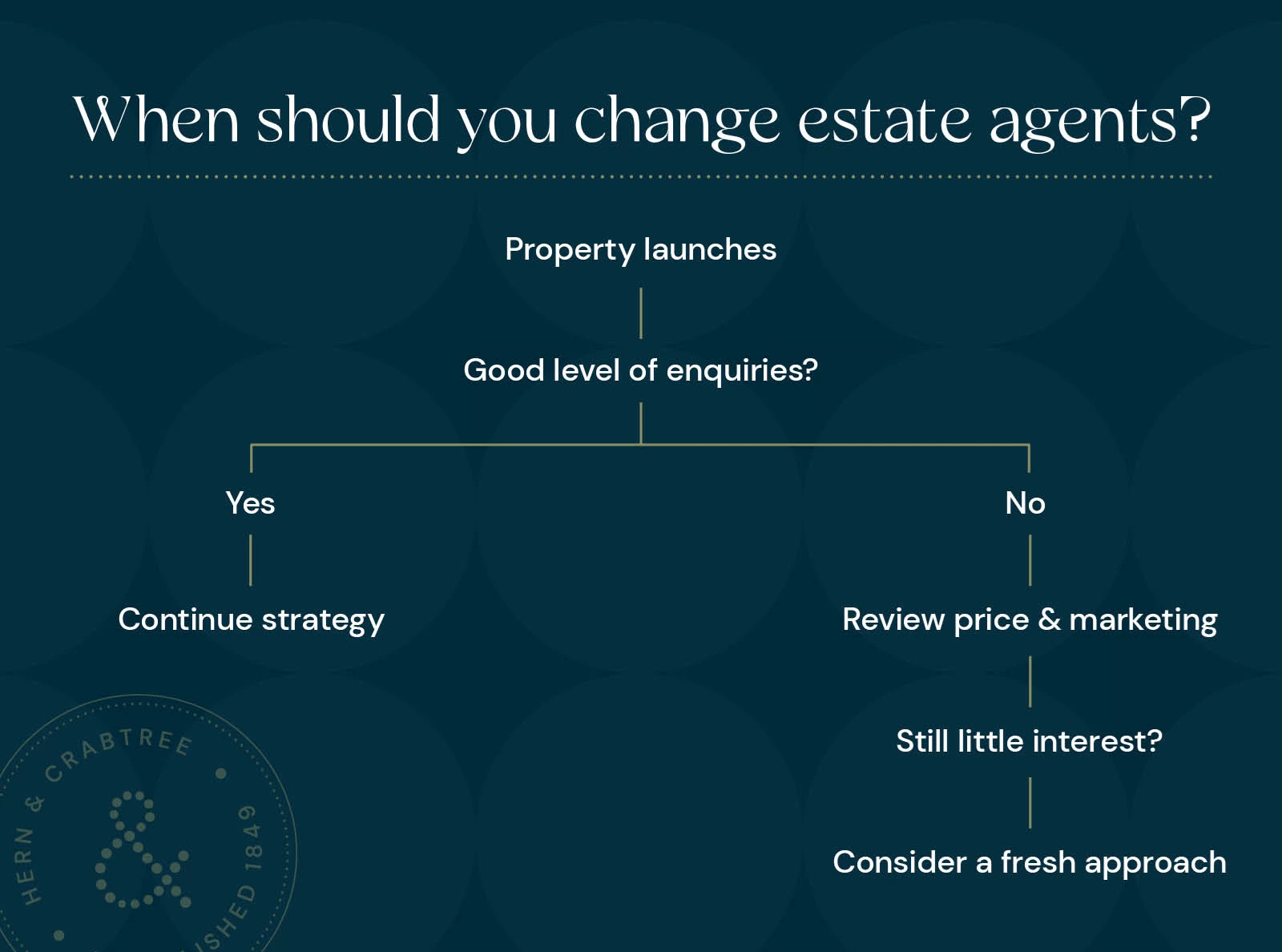
When should you think about changing estate agents?
There isn’t a fixed timescale.
Some homes naturally take longer to sell than others.
Instead of focusing on how many weeks your property has been on the market, think about whether there’s a clear strategy in place.
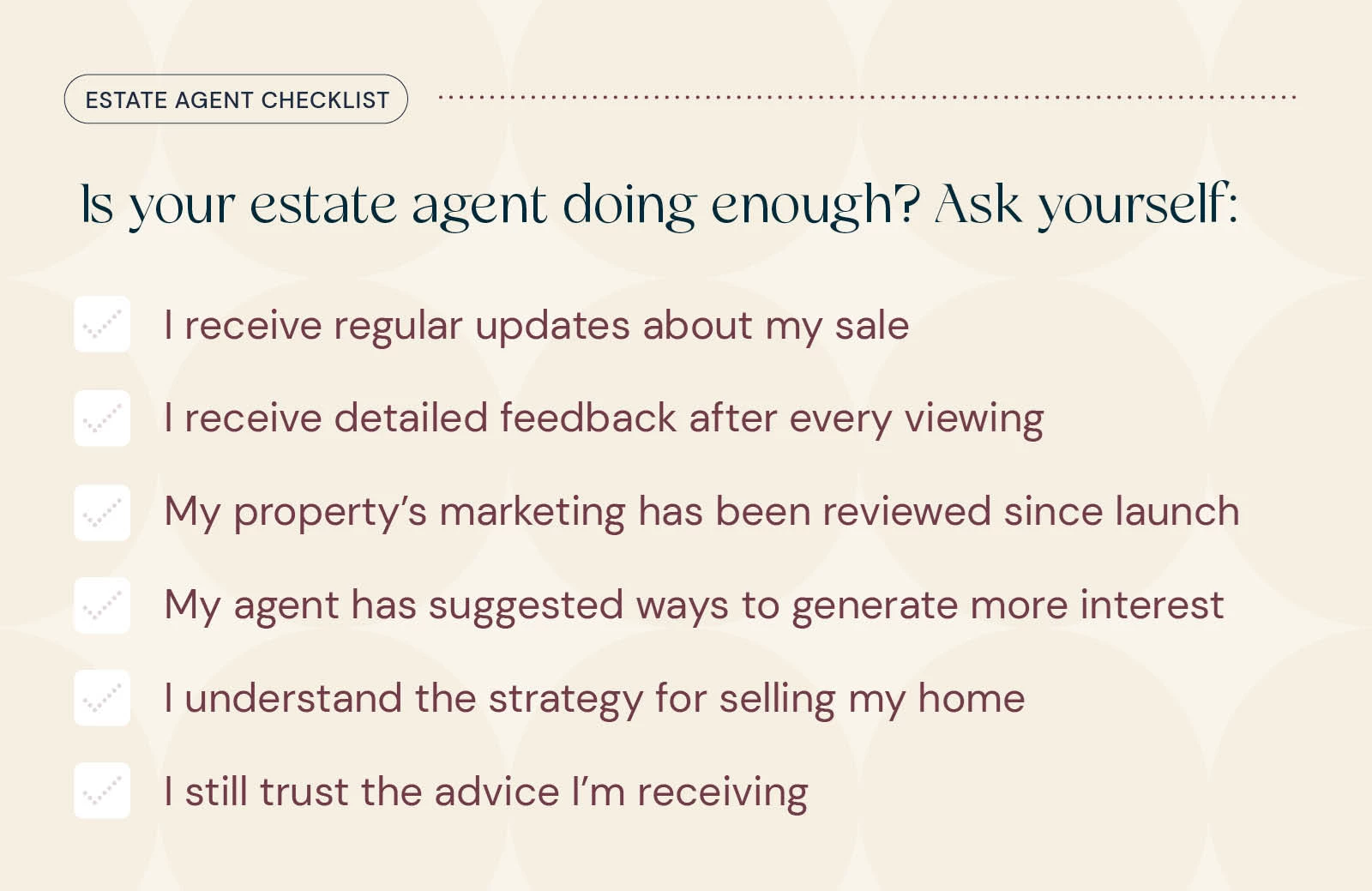
Ask yourself:
Am I receiving regular communication?
Do I receive detailed feedback after viewings?
Has the marketing been reviewed since launch?
Does my agent have clear recommendations if interest is low?
Do I still have confidence in their advice?
If the answer to several of these questions is no, it may be worth considering a fresh approach.
Can you change estate agents?
Usually, yes.
The first step is checking your current agreement.
Many estate agents ask sellers to sign a sole agency contract that includes a minimum term and a notice period.
Once those obligations have been met, you’re free to appoint another agent if you believe a different approach would give your property a better chance of selling.
It’s always worth reading the agreement carefully before making any decisions.
What should you look for in a new estate agent?
It can be tempting to compare agents by two things alone.
Who offers the highest valuation? Who charges the lowest fee?
Neither tells you very much about how successfully they’ll sell your home.
Instead, ask questions such as:
How will you market my property?
How often will you contact me?
Who carries out the viewings?
How do you qualify buyers?
What happens if interest is lower than expected?
An experienced agent should be able to answer these questions confidently and explain the reasoning behind their recommendations.
You can also carry out your own research.
Take a look at the properties each agent is currently marketing. Read recent reviews. Compare the quality of their photography and property descriptions.
One useful indicator is the proportion of properties marked as Sold STC compared with those still available.
No single statistic tells the whole story, but it can provide a helpful insight into how effectively an agent converts listings into successful sales.
Can a fresh start really make a difference?
It often can.
Changing estate agents gives you the opportunity to relaunch your property rather than simply continuing where the previous marketing left off.
That might include:
new photography
updated descriptions
revised pricing
fresh exposure on the property portals
renewed promotion through social media and email marketing
We’ve seen this make a real difference.
One homeowner approached us after their property had spent more than 100 days on the market with another agent.
After reviewing the marketing, refreshing the photography and relaunching the property, interest increased significantly. Within days, a sale was agreed for above the asking price.
Every property is different, and no estate agent can promise the same outcome every time.
What it demonstrates is the value of looking at a property with fresh eyes rather than simply waiting for circumstances to change.
Three questions to ask before making a decision
Before changing estate agents, ask yourself three simple questions.
Do I understand why my property hasn’t sold?
A good agent should be able to explain this clearly.
Has anything changed since my property was launched?
If the marketing and strategy are exactly the same months later, it may be time to try something different.
Do I still trust the advice I’m receiving?
Selling your home is too important to feel uncertain about the support you’re getting.
Frequently asked questions
How long should I wait before changing estate agents?
There isn’t a standard timeframe. Instead, focus on the level of interest your property is attracting and whether your estate agent has a clear strategy for improving it.
Is changing estate agents expensive?
Usually not, provided you’ve met the terms of your current agreement. Always check your contract before appointing another agent.
Will buyers notice if I change estate agents?
Yes. A new agent will often relaunch the property with updated marketing, giving buyers another opportunity to consider it.
Is it better to reduce the asking price or change estate agents?
Sometimes one is enough. Sometimes both are needed. A good estate agent should explain whether pricing, presentation or marketing is limiting buyer interest before recommending any changes.
So, should you change estate agents?
Changing estate agents isn’t a guaranteed solution, but neither is staying with an approach that isn’t delivering results.
If your property has lost momentum, communication has become inconsistent or you’re no longer confident in the advice you’re receiving, a fresh perspective may be exactly what’s needed.
The best estate agents don’t simply list properties. They keep reviewing, adapting and looking for new ways to connect the right buyer with the right home.
Sometimes that’s the difference between a property that sits on the market and one that successfully moves to sold.